Northwest Lagotto · Lynden, Washington
Training Your
Lagotto Romagnolo
What the Science Says, and What Works in Practice
The Lagotto Romagnolo is a highly trainable breed that responds best to positive reinforcement, short sessions, and patience. They are intelligent and eager to work with their handler, but they are also sensitive dogs that do not respond well to force or harsh corrections. Most Lagotto puppies from Northwest Lagotto arrive home already practicing manding, sitting to request attention, a skill learned as early as four weeks of age under the Puppy Culture protocol.
Every puppy that leaves Northwest Lagotto already knows something.
Not tricks. Not commands. Something more fundamental: that their own behavior has consequences. That sitting calmly, what trainers call manding, produces good things. That the world is responsive, that they have agency in it, and that the humans around them are worth paying attention to.
That knowledge was established here, in the weeks before they came to you, under the Puppy Culture protocol we have followed with every litter. It is the foundation. What you build on it, and how carefully you build it, will determine the dog you live with for the next fifteen years.
This guide covers the science of how dogs learn, the specific techniques that work for this breed, and what to do, phase by phase, from the day your puppy arrives home until they reach adulthood. It is not a generic puppy guide. It is written for Lagotto owners, from someone who works with these dogs every day.
Where Your Puppy Starts:
The Puppy Culture Foundation
Puppy Culture is a structured early neurological stimulation and socialization protocol developed by Jane Killion, grounded in decades of research into canine developmental stages. It begins in the first days of life with daily brief handling exercises, progresses through deliberate sound desensitization, problem-solving challenges, and, crucially, the introduction of manding as the puppy’s primary communication tool.
Manding means sitting to ask for things. Not because the puppy was told to sit, not because a hand was pushed down on their hindquarters, but because they discovered on their own that sitting near a human who has something desirable produces results. It is the purest form of operant conditioning: a behavior that emerges spontaneously, is reinforced, and therefore increases.
The video below was filmed at Northwest Lagotto with a five-week-old puppy during their first-ever manding session. Watch what happens when I simply wait, no steps, no luring, no physical guidance. The puppy experiments. The puppy finds the behavior. The puppy figures out how to repeat it. In under five minutes.
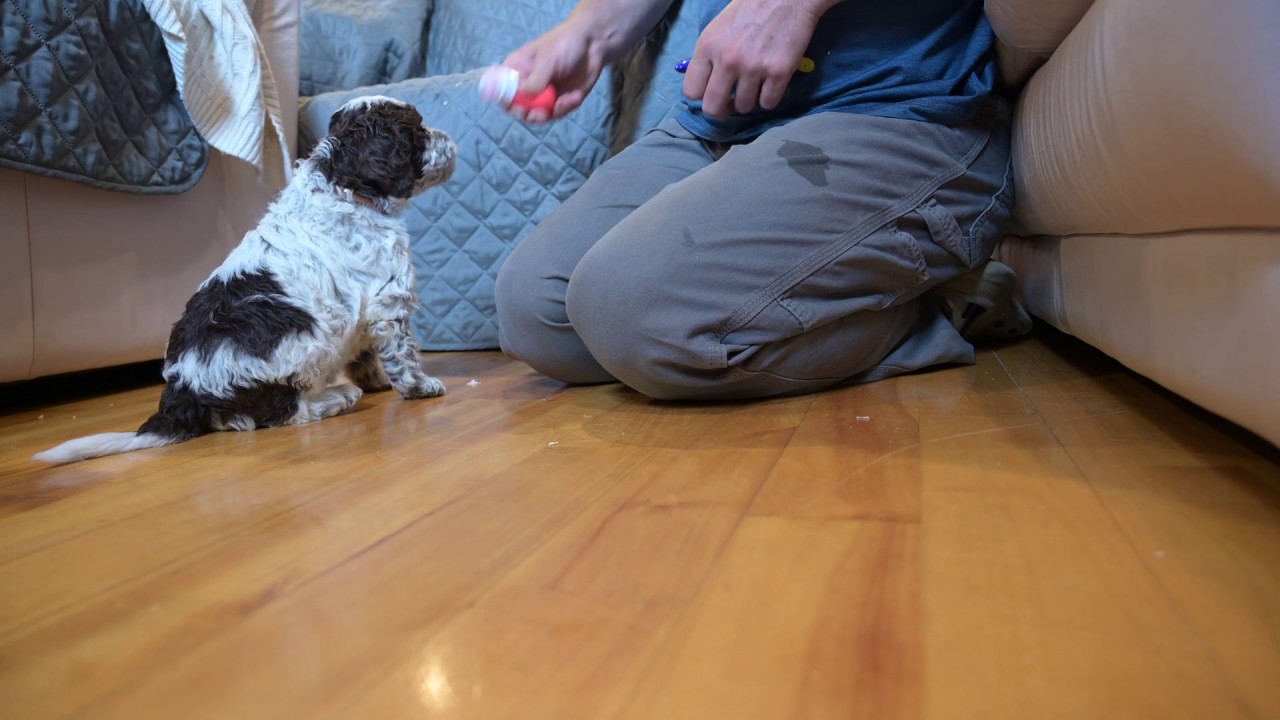
What you are watching is shaping, the technique of reinforcing successive approximations toward a desired behavior, described first by B.F. Skinner in the 1950s and refined by trainers and researchers in the decades since. The puppy is not being trained. The puppy is training themselves, guided only by the timing of a reward. It is one of the most powerful things in animal learning, and it is how we start every puppy here from week five.
Your puppy arrives already fluent in this conversation. The single most important thing you can do in the first weeks at home is not to start fresh. It is to not break what already exists.
How Dogs Actually Learn:
The Science Worth Knowing
Understanding a small amount of learning theory will make you a significantly better trainer. Not because you need to speak the language, but because understanding why something works helps you do it more consistently and with more confidence.
Dogs learn through operant conditioning: they repeat behaviors that produce good outcomes and reduce behaviors that produce nothing or produce negative outcomes. This is not a training philosophy. It is a description of how the mammalian nervous system works, established by Skinner and replicated in thousands of studies since. There are no exceptions. It applies to every dog, in every context, every time.
The marker signal.
A clicker, or a precisely timed verbal marker like “yes”, functions as a bridge between the behavior and the reward. The dog does the thing, hears the click, receives the treat. With repetition, the click itself takes on predictive value: it tells the brain that what just happened was the right thing, even before the treat arrives. Timing is everything. A marker that arrives one second late is telling the dog something different from what you intended. The cleaner your timing, the faster your dog learns.
The second video below was filmed here with an eight-week-old puppy learning to go to place. Watch how the clicker does the communicating, the moment a paw touches the bed, the click marks it, and the puppy figures out the game rapidly. Within minutes, the puppy is jumping onto the bed and manding, awaiting reinforcement. Again: no leading, no stepping, no luring. Just a precisely timed consequence.

Dogs trained once or twice a week achieved significantly better acquisition than dogs trained daily. Dogs trained in a single daily session learned faster than dogs trained in three back-to-back sessions. The highest-performing group trained weekly with a single session. The lowest-performing group trained daily in multiple sessions.
Phase One:
The First Eight Weeks at Home (8–16 weeks)
The window between eight and sixteen weeks is the most consequential period of your dog’s social development. It corresponds to the tail end of what researchers Scott and Fuller identified in 1965 as the primary socialization period, the developmental window during which a puppy’s brain is maximally receptive to learning that novel people, animals, surfaces, sounds, and environments are safe.
This is not a long window. It closes. And what is not encountered calmly and positively during this period will be more difficult to address later.
Protecting the mand.
In the first days at home, simply reinforce every sit your puppy offers in your presence. Not with a command. Not with a word at all, initially. Just a treat produced calmly at the moment all four paws are on the floor and the bottom is down. Your puppy arrived knowing that sitting near a person is worth doing. You are confirming that this is still true in the new environment.
The name.
Say your puppy’s name once, warmly, and mark and treat the moment they orient toward you. Do this in short bursts, five repetitions, session over. Within days you will have a puppy that snaps their head toward you reliably on their name alone. That attention response is the foundation of every recall you will ever build.
Place.
The place behavior, going to a designated bed or mat on cue and remaining there, is one of the most practically useful behaviors you can teach, and this is the right age to begin it, as the video above demonstrates. Start with a single step onto the bed marked and rewarded. Build duration in small increments, always returning to reward before the puppy breaks the stay rather than after. The rule is: never let the puppy succeed at leaving before you’ve released them.
Phase Two:
Building Fluency (4–6 months)
By four months your puppy has a working vocabulary of behaviors established in low-distraction environments. The task now is fluency, the ability to perform those behaviors reliably in the presence of competing stimuli.
This is where many owners plateau. The puppy sits perfectly in the kitchen and falls apart in the park. This is not disobedience. It is the entirely predictable result of a behavior that was trained in one context and not yet generalized to others. Dogs do not generalize automatically. A behavior trained in your living room needs to be proofed, gradually, systematically, in progressively more stimulating environments.
The 80% rule.
Do not increase difficulty until the dog is succeeding roughly 80% of the time at the current level. If you push too fast, you are not challenging your dog. You are introducing error that erodes confidence. Errors are training feedback. Too many errors in a row means the criteria is too high; bring it back down.
Adding duration and distance to place.
By five months, your puppy should be able to hold a place stay for thirty to sixty seconds with you in the same room. Begin adding distance in small increments: one step away, return, reward. Two steps, return, reward. The three D’s of stay training, Duration, Distance, Distraction, should be built separately, not simultaneously. Do not add a distraction until duration and distance are solid. Do not add distance while simultaneously increasing duration.
Leash manners.
Loose leash walking is the behavior new owners find most difficult and most important in daily life. The principle is simple and the execution requires patience: a tight leash produces no forward movement. The moment tension leaves the lead, forward movement resumes. Mark and reward any moment your dog is at your side with the lead loose. This is not complicated. It requires repetition and consistent follow-through, not equipment.
Phase Three:
Adolescence (6–18 months)
This is the phase nobody warns you about adequately.
At roughly six months, your dog enters adolescence, a period of significant neurological reorganization that researchers have now confirmed produces predictable behavioral changes.
The first rigorous scientific confirmation of what dog owners have known anecdotally for years: adolescent dogs disobey their owners more than younger puppies do, and dogs with less secure attachments enter puberty earlier.
What this produces in practice: behaviors that were reliable at five months may regress. A recall that worked every time may start failing. A puppy that was calm around strangers may become reactive. A dog that seemed to have mastered loose leash walking will pull again. Veterinarians and dog behaviorists note that adolescence is among the most important periods for persistent training, positive reinforcement, and tolerance, and that these natural behaviors, when not understood, are commonly misread as disobedience or aggression.
The second fear period.
Between roughly six and fourteen months, many dogs experience a secondary fear period, a window during which they may suddenly show anxiety about things they previously accepted calmly. This is a normal part of development. The response is the same as it was during the primary socialization period: gentle exposure, positive association, no forcing. A puppy who is frightened and forced through the frightening thing does not become braver. They become more afraid, with the added learning that their signals of distress are ignored.
What works during adolescence.
Keep sessions short. Keep criteria achievable. Find things your dog can succeed at and do those things, frequently, in new environments. Reward heavily for engagement with you in the presence of distractions, that sustained attention is harder to produce now than it was at twelve weeks, and it is worth more when you get it. Maintain the mand as a default behavior: any time your dog wants anything, the sit comes first. That habit, maintained through adolescence, produces an adult dog with genuine impulse control rather than a dog that has simply outgrown their most disruptive behaviors.
Phase Four:
The Adult Dog (18 months and beyond)
Most Lagotti reach something approaching behavioral maturity somewhere between eighteen months and two years, though some individuals take longer. The brain settles. The impulse control that was missing at nine months becomes available. The dog you have been training toward begins to appear reliably.
By this stage, formal training sessions are less important than integrated practice. A dog who has been trained well will take cues from their owner throughout the day, a sit at the door before it opens, a place cue at mealtimes, a down at the café table. This integration is the goal: not a dog that performs on command, but a dog that moves through the world with you in a way that works for both of you.
The Lagotto’s nose.
The Lagotto Romagnolo has been selected over centuries for scenting ability, an extraordinary nose combined with the drive and independence to use it. That heritage can be channelled deliberately through nose work and scent detection, two activities that are ideal for this breed and that provide the kind of deep mental satisfaction that a walk around the block simply cannot offer. Even basic nose work, hiding a treat under one of three cups and asking the dog to find it, produces a level of engagement and tiredness that is qualitatively different from physical exercise alone. If you have a Lagotto with excess energy, their nose is the place to direct it. How the Lagotto nose actually works →

Common mistakes worth naming.
We remain available to our families for exactly these questions, the ones that arise at five months when the recall stops working, or at ten months when the adolescent chaos peaks, or at two years when everything suddenly clicks. You are not navigating this alone. If you have a question that this guide has not answered, use the contact form on our Resources & Contact page. We are glad to hear from you.
If you are ready to begin the conversation about a puppy, join our waitlist →More from Northwest Lagotto