The Breeder’s Guide
Grooming Your
Lagotto Romagnolo
A practical guide from someone who does it himself, from the first puppy clip to the settled adult coat.
When people ask me what surprised me most about this breed, the coat is usually part of the answer.
Not because it’s difficult, it isn’t, once you understand it. But because it operates by rules that are almost the opposite of what most dog owners expect. You don’t brush it out between grooms. You don’t blow-dry it. You don’t use conditioner. You clip before the bath, not after. And the goal is never perfection. It’s rusticity, the lived-in look of a working dog that has been cared for rather than primped.
The Lagotto coat is genuinely beautiful when managed well, and genuinely miserable for the dog when it isn’t. This guide covers everything I’ve learned from grooming my own dogs over many years, what the coat needs, when it needs it, what tools actually work, what a good groomer looks like, and how to turn grooming from a chore into something your dog looks forward to.
Section i
Understanding the Coat
Before you can manage the Lagotto coat, you need to understand what it actually is, because it behaves differently from almost every other breed you may have encountered.
The Lagotto has a double coat: a dense, woolly undercoat designed to insulate against cold water, and an outer coat of thick, ring-shaped curls that are almost waterproof in their natural state. The coat is made of hair rather than fur, which means it grows continuously and does not shed in the conventional sense. This is genuinely good news for people with allergies and for anyone who doesn’t want dog hair on their furniture. It comes with a trade-off: a coat that doesn’t shed must be clipped, and a coat left unmanaged will not simply get long and scruffy. It will felt.
Felting is different from matting, and the distinction matters. Matting is a tangle. Felting is what happens when the curly undercoat fuses to itself at the root level, essentially compressing into a dense, solid layer against the skin. A matted coat can often be worked through with patience and the right tools. A felted coat cannot. It must be clipped off entirely, which is uncomfortable for the dog and distressing for the owner. Regular grooming is not optional with this breed. It is the difference between a coat that is a pleasure and a coat that has become a welfare problem.
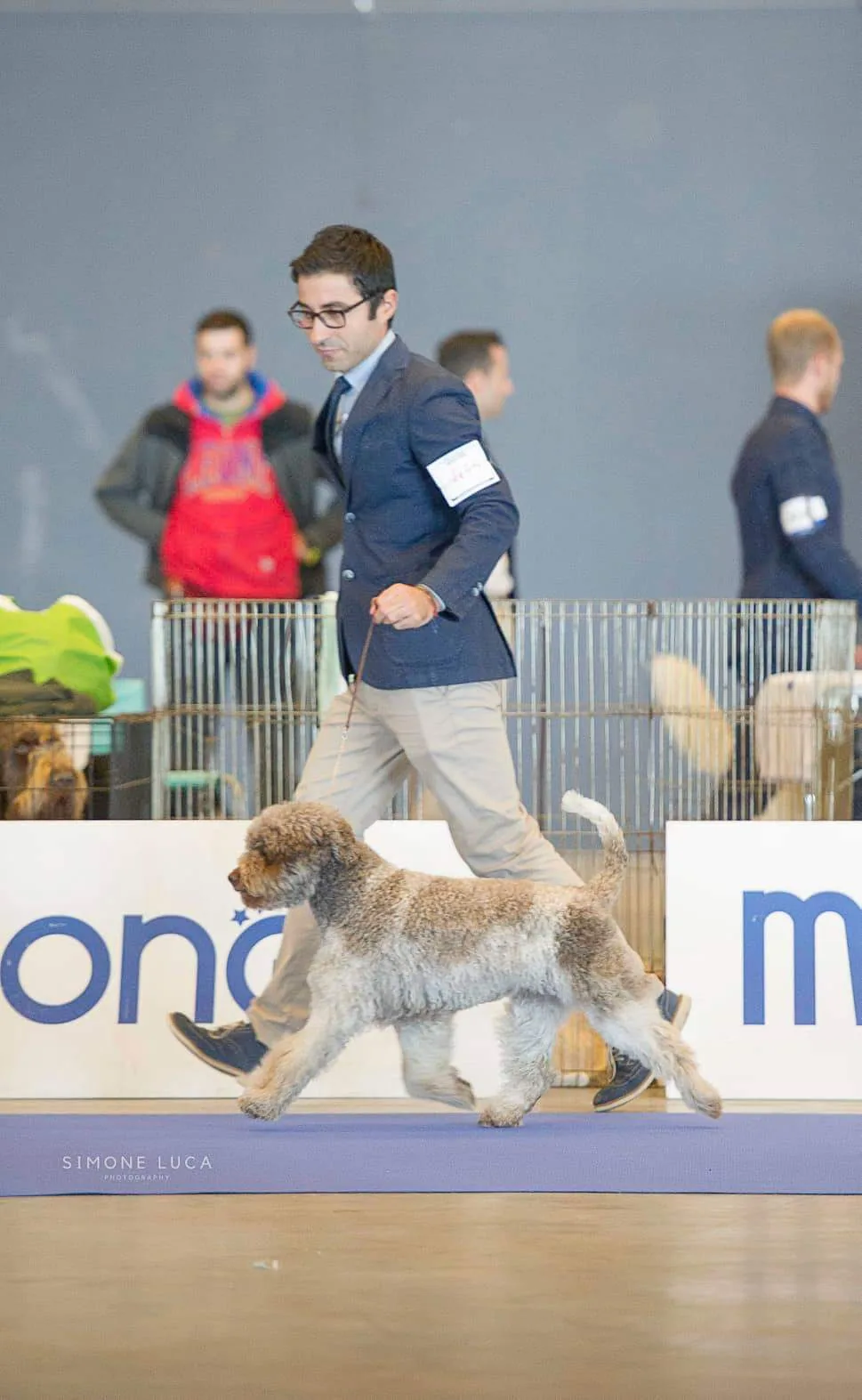
The breed standard describes the ideal coat as rustic, which is worth holding in mind every time you groom. A Lagotto should never look like a Poodle or a Bichon Frisé. The curls should be visible, natural, and dense. The dog should look like what it is: an ancient working breed from northern Italy, cared for but not fussed over.
Section ii
The Puppy Coat & the Transition
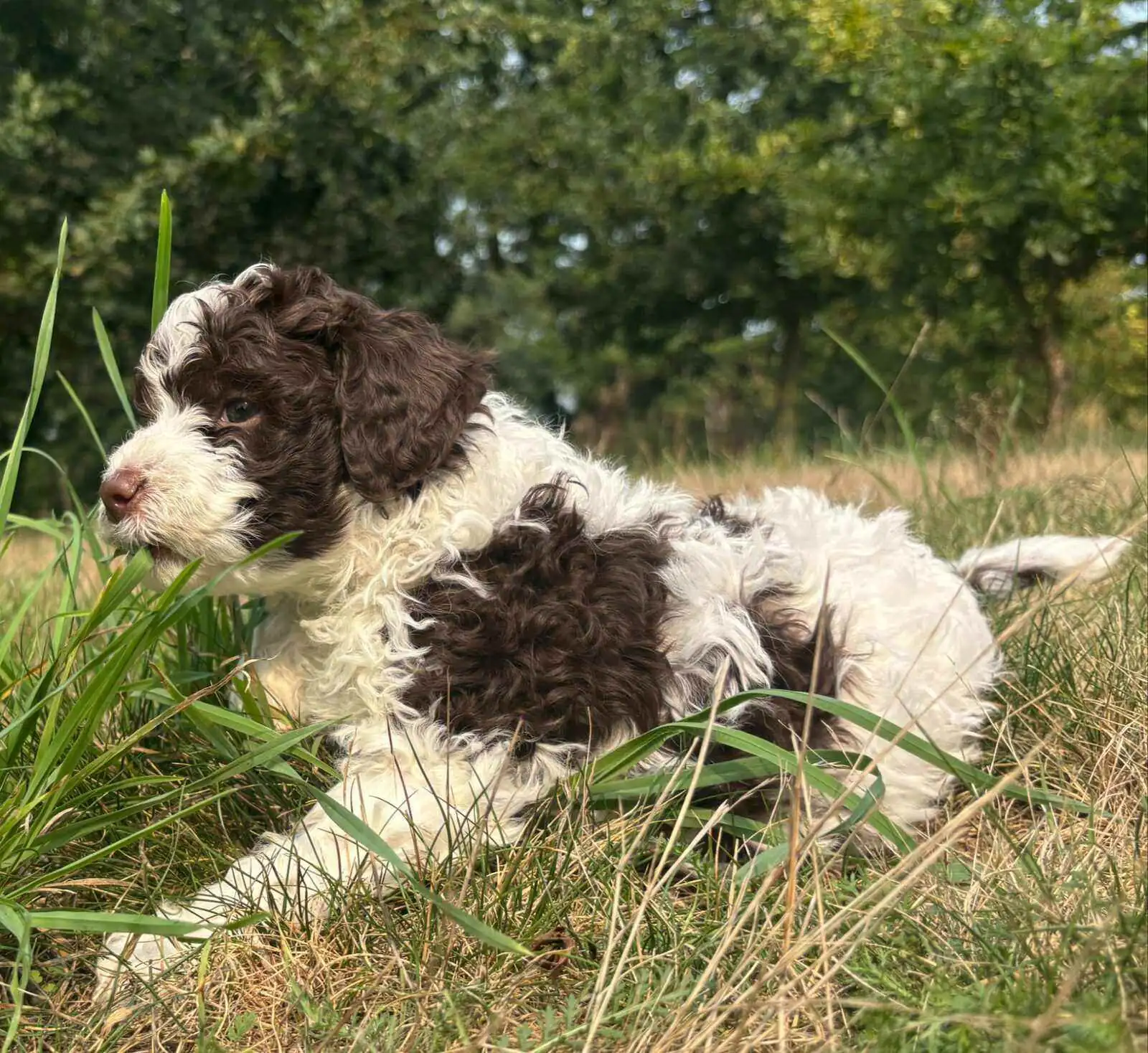
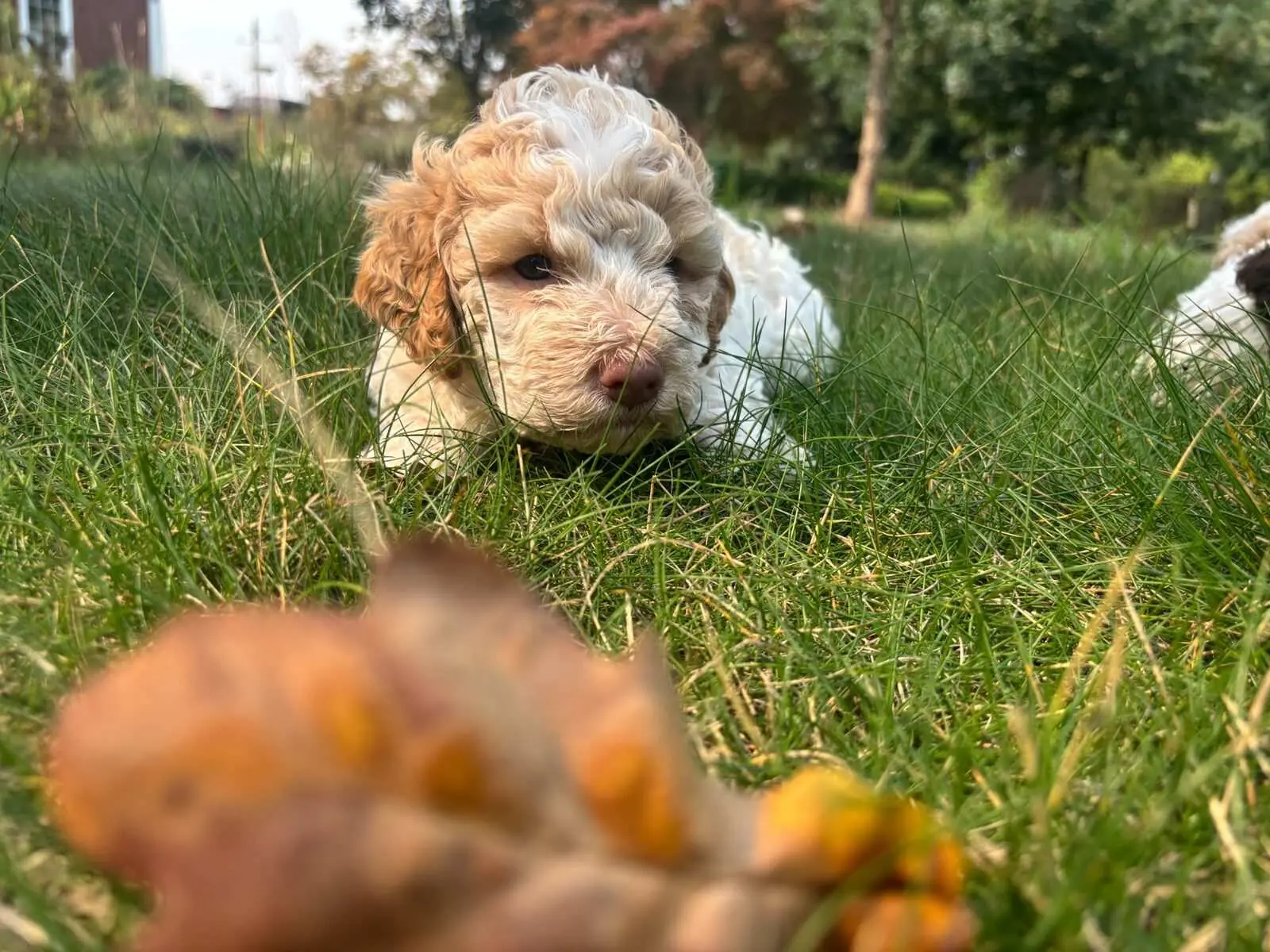
A Lagotto puppy arrives with a soft, open coat that bears little resemblance to the dense adult curl. This is normal. The adult coat develops gradually, typically completing its transition somewhere between twelve and twenty-four months, though some coats take longer.
There are two things every new Lagotto owner needs to know about this transition.
The first clip matters. The first full clip, recommended around three months of age, is not just tidying up a puppy coat. It actively encourages the curl to develop correctly. A puppy coat left unclipped grows long and heavy, and that weight suppresses the curl from forming. Clip the puppy coat short at around twelve to fourteen weeks and you give the emerging adult coat the best possible start.
The transition period is the hardest. Between roughly nine and eighteen months, the puppy coat and the adult coat coexist, and the resulting mixed texture is significantly more prone to felting than either the puppy coat before it or the adult coat after it. This is the period when new owners are most likely to be caught off guard by a mat behind the ear or under an armpit that appeared seemingly overnight. During this window, increase your checking frequency. Run a metal comb through the coat every week or so, not to brush it out, but simply to find any areas of concern before they become problems. See how we begin preparing every puppy for grooming from day three.
Once the adult coat is fully established, management becomes considerably more predictable. Most pet owners settle into a rhythm of professional clipping every six to eight weeks, with minimal maintenance between visits.
Section iii
The Correct Clip
The Lagotto is clipped to the lines of its body, not sculpted, not shaped into a silhouette that isn’t there. The coat follows the dog.
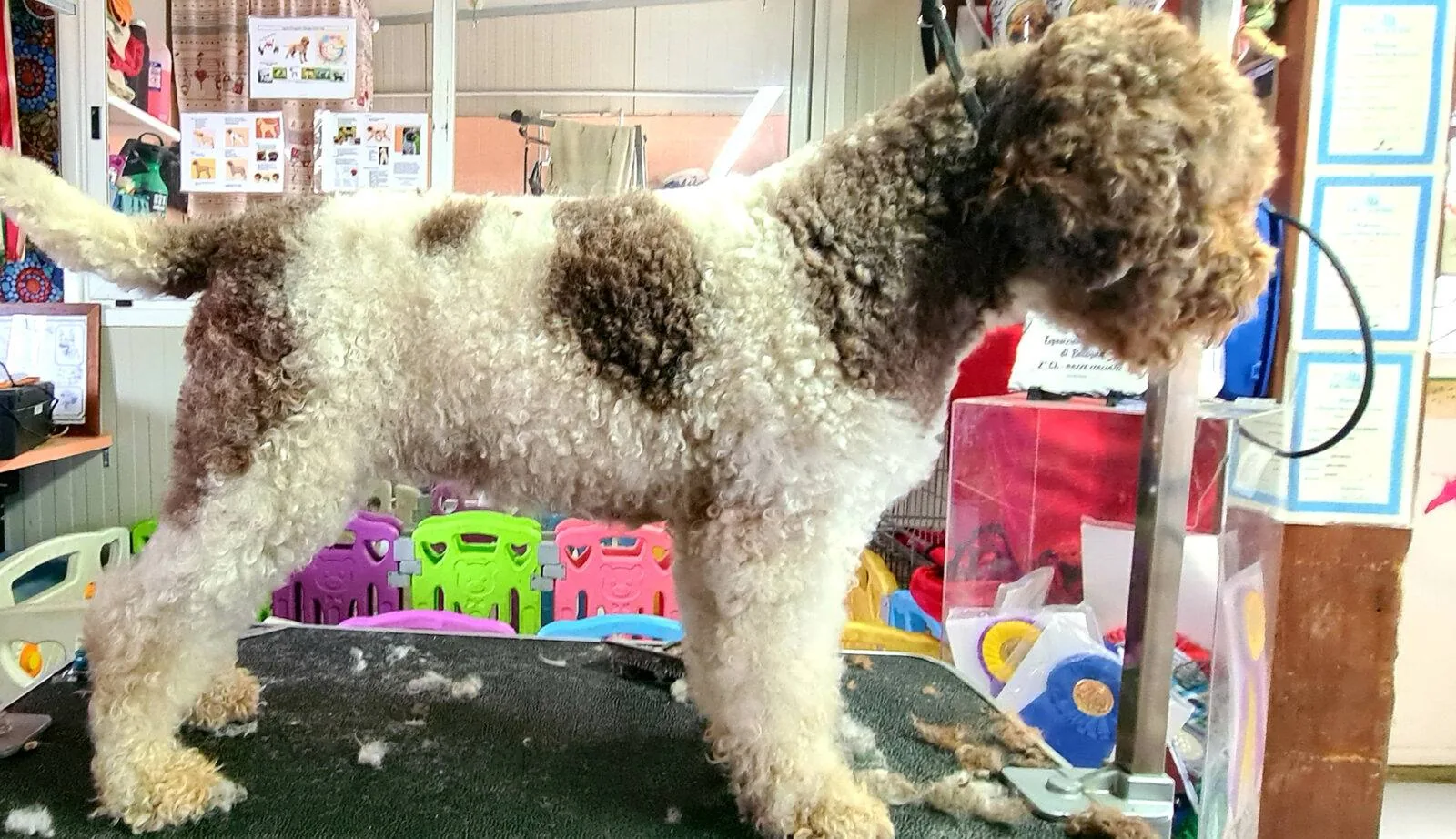
The body coat is kept uniform, typically one to one and a half inches in curled length. The legs are left slightly longer and should look like columns, not feathered, not shaped, simply present. The tail is trimmed in a tapered shape, in traditional Lagotto grooming, the description used is a carrot. The head is rounded, with the eyes clearly visible and the characteristic beard, eyebrows, and whiskers preserved. The ears are trimmed to the leather at the edges, meaning the fringe is removed so the ear finishes cleanly at its own edge rather than hanging beyond it.
The area around the genitals and anus is clipped short for hygiene. The pads of the feet are trimmed to remove excess coat between the toes, which otherwise traps debris, mud, and moisture.
One important note for owners who use professional groomers: many groomers, particularly those without experience with the breed, default to treating a Lagotto like a Poodle. They will brush the coat out, blow it dry with a force dryer, and clip through the fluffed result. This destroys the curl structure and produces a coat that is more prone to matting, not less. If you use a professional groomer, the guidance in the final section of this page will help you find one who understands this breed.
Section iv
Clip Before the Bath:
Not After
This is the piece of Lagotto grooming knowledge that surprises most people, including experienced dog owners.
For pet coat management, the clipping and scissoring work is done before the bath, not after. Here is why: when you bathe the dog first, the coat softens and expands, giving you a false impression of its actual volume and shape. Once it dries and the curls reset, the shape you cut will have shifted. Clip dry, on the dog’s natural coat, and what you see is what you get.
After clipping, bathe the dog thoroughly with a quality shampoo, more on that in the bathing section, and then allow the coat to air dry. Do not rub the coat with a towel. Do not use a force dryer to blow the coat out. Both actions break up the ring-shaped curl structure and leave you with a coat that will mat faster between grooms. A Lagotto should leave the bath damp and be allowed to dry naturally, at its own pace.
Section v
Bathing:
What the Coat Actually Needs
The Lagotto does not need frequent bathing. Once a month is appropriate for most dogs in normal household conditions. Dogs that spend significant time outdoors, in water, or working in fields may need more frequent attention, but over-bathing strips the natural oils from the coat and compromises the water-resistant properties that are one of its most useful features.
Use a quality pet shampoo that does not strip oil from the coat. This is not the place for a budget product. Look specifically for shampoos formulated for curly or double coats.
After bathing: no towel rubbing, no force drying. Gently press excess water out with a towel if needed, then allow the dog to air dry completely before any further grooming or clipping work.
Section vi
The Right Tools, Chosen Correctly
You do not need a professional-level kit to maintain a Lagotto at home between grooms. You need a few specific things, chosen correctly.
Metal comb with wide and fine teeth
The single most important tool in your kit. Use the wide-tooth end for the body coat and the fine-tooth end for checking behind the ears and around the collar. Run it from root to tip regularly. If it catches, you have found a mat before it became a felt.
Wooden pin brush
Gentler on curl structure than wire pins. Use it after outdoor activity to remove leaves, seeds, and debris. Wire slicker brushes are not recommended for Lagotti, repeated use breaks up the curl and accelerates tangling.
Clippers with blade attachments
For owners who clip their own dogs. A number 4 blade leaves approximately 9.5mm of coat and works well for general pet maintenance. A number 9 or 10 blade clips much closer and is used for a full reset once or twice a year.
Sharp scissors
Straight for body work, curved for the head and face. Professional-grade scissors are worth the investment if you groom regularly. Dull scissors pull rather than cut.
Ear powder
Used when plucking hair from the ear canal. Improves grip on fine hair and makes the process faster and more comfortable for the dog.
Styptic powder
Keep this on hand for nail trimming. Apply immediately if the quick is nicked. It stops bleeding quickly and is far more effective than improvised alternatives. More detail in the following section.
Section vii
Eyes, Ears & Nails, The Full Picture
Eyes. Keep the hair around the eyes trimmed short enough that it does not irritate the eye surface or restrict the dog’s vision. The characteristic eyebrows and facial furnishings are part of the breed’s look and should be preserved, but they should frame the eye, not obscure it. Katrien van Gemert, widely regarded as the leading authority on Lagotto grooming, demonstrates a specific technique for this: cut one line straight up from the inner corner of the eye and a second line upward from the outer corner. If needed, remove a small amount of hair between these lines to open the eye, but always evaluate between cuts and take less than you think you need. The goal is to make the eye visible while keeping the head round-shaped and natural. Cutting a circle around the eye creates a visible hole in the furnishings; the two-line method avoids this. Always support the dog’s head with your free hand and keep scissor points directed away from the eye. Check regularly for any discharge, redness, or signs of irritation.
Ears. The Lagotto ear requires two distinct types of attention, and getting this right is essential. The breed is prone to ear infections when airflow to the canal is restricted. The outer ear leather should be trimmed so the fringe does not extend beyond the edge of the ear, this keeps the ear looking clean and prevents excess hair from trapping debris. Katrien van Gemert emphasises removing hair from under the ear flap to promote airflow, scissoring carefully with the ear lifted and supported. The inner ear canal may develop hair growth that, if left unmanaged, creates conditions for wax buildup, moisture retention, and infection. Remove only naturally loose hairs from the canal, van Gemert recommends using thumb and third finger to gently pull what comes free, rather than aggressive stripping. If your dog shows signs of ear discomfort, head shaking, pawing at the ear, odour, consult your veterinarian rather than attempting to address it yourself.
The area behind the ears and under the ear leather is one of the most common sites for matting in this breed. Check it every week without exception.
Nails. Lagotto nails are long and curved, an adaptation from their history as digging dogs, and the physical feature that makes them so effective at unearthing truffles. The quick, the blood vessel inside the nail, is correspondingly longer than in most breeds. Trim conservatively, taking small amounts at a time. A Lagotto whose quick has been cut to the point of bleeding will remember it for a long time, and a dog with a negative nail-trimming experience is significantly harder to manage at every subsequent session. Keep styptic powder on hand. If you are uncertain, ask your veterinarian or groomer to demonstrate the correct technique before attempting it alone.
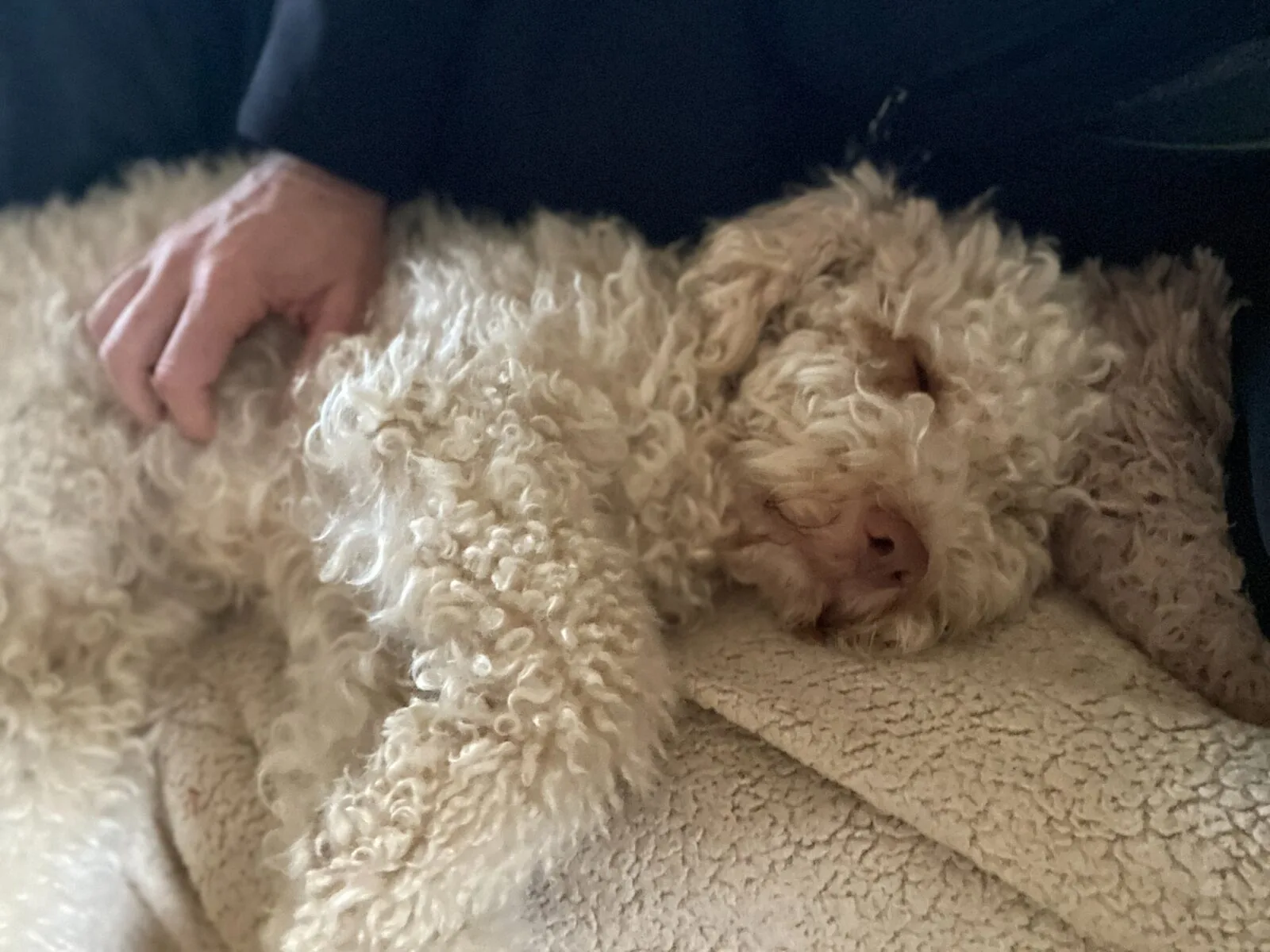
The Lagotto nail is designed by centuries of selection for digging. It is longer, more curved, and more vascular than in most breeds. Respect that. Trim little and often rather than correcting neglect in a single session.
, Louise Ferguson, Lagotto Romagnolo Club of Great Britain
Section viii
Finding a Groomer Who Knows This Breed
If you choose to use a professional groomer, which is a perfectly reasonable choice, particularly for owners who find the clipping work daunting, finding one with genuine Lagotto experience matters more than it does for most breeds.
Ask specifically whether they have groomed Lagotti before. Ask what their approach is to drying the coat. Ask whether they brush out the coat before clipping. The answers will tell you quickly whether this is a groomer who understands what the coat needs or one who will treat it like a Poodle.
A professional Lagotto groom in your area will typically cost between $120 and $150. If the price is significantly lower, ask why, the time required to do this breed correctly does not support a budget price point.
You Are Not on Your Own With This
If you have a Northwest Lagotto puppy or are on our waitlist, grooming guidance is part of what I offer as your breeder. Whether you want a recommendation for a groomer in your area who has experience with the breed, a walkthrough of the clipping process via video call, or just reassurance that what you’re seeing during the transition is normal, reach out.
The single best resource on Lagotto grooming is the book Lagotto Romagnolo Grooming: The Art of Keeping It Rustic by Katrien van Gemert and Camilla Backman. Van Gemert is a Dutch breeder and groomer from Kennel Rozebottel’s who has spent over fifteen years working exclusively with Lagotto coats. She is an international breed judge, and her breeding program has produced AKC champions. I own the book and consider it essential reading for anyone who wants to understand this coat properly. Her YouTube channel also demonstrates the specific techniques described in this guide, eyes, ears, nails, paw pads, and puppy habituation, and I recommend watching them before your first grooming appointment.
The grooming notes published by the Lagotto Romagnolo Club of Great Britain are also excellent and available on their website. Between van Gemert’s book, her videos, and the LRCGB notes, you will have a better understanding of this coat than most professional groomers.
The goal is a dog that is comfortable, healthy, and well looked after, not a dog that looks like it just left a show ring. Once you understand what this coat needs, it is genuinely manageable. Ask a question any time, or if you’re considering a puppy, start the conversation here.
Questions About Your Dog’s Coat?
Every Lagotto coat is different. If you have a question about the transition, a mat you can’t resolve, or you’re trying to find a groomer who understands this breed, I’m glad to help.
More from Northwest Lagotto